Informational Searches Want an Answer. Buying Searches Want a Company.
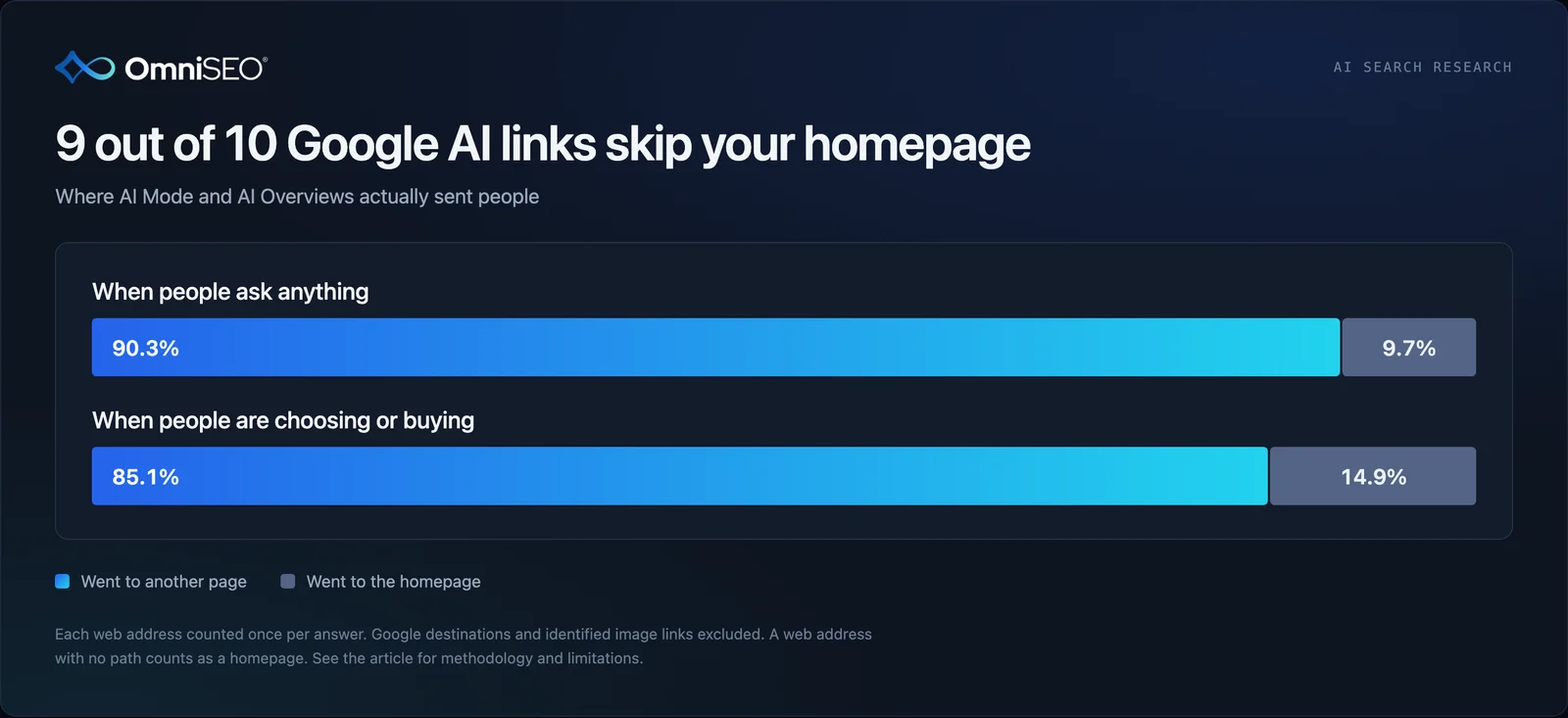
Across every eligible Google AI Mode and AI Overview answer in our archive, 90.3% of recorded page links pointed past the homepage. On questions about choosing or buying, it was 85.1%. That gap turned out to be the interesting part.
Start Free TrialTrack how your brand appears across Google AI Mode, AI Overviews, and ChatGPT.
We went through every eligible Google AI Mode and AI Overview answer in our archive and counted where each link landed. Across all of it, 90.3% pointed past the homepage. On the questions about choosing or buying something, that dropped to 85.1%.
A five point gap sounds like rounding. It isn't. It means roughly one in seven links on buying questions still lands on a homepage, and once you know why, it changes what you work on.
The company question
Informational questions are looking for an answer. Buying questions are looking for a company.
When someone asks how a thing works, the best source is a page that explains it. When someone asks who can do this for them, the answer has to point at a business, and a homepage is often the most direct way to do that.
That is the whole finding, and I'd rather state it in one line than dress it up. Your deep pages answer the question. Your homepage answers who is answering it.
It also explains the shape of the data better than "AI prefers deep pages" does. Informational questions made up a large share of what we reviewed, and they pull reference pages almost by definition. Strip those out, leave the buying questions, and the homepage climbs back into the mix.
Your brand has to hold up away from your own site
Here is the part I think matters most, and it took me a while to see it in the numbers.
If a buying question is really asking "who can do this," then the answer depends on what the web already says about you. Not what your site says. What everybody else says.
The answers we reviewed leaned on outside sources constantly, mostly directory listings and publisher comparisons, with the occasional institutional page. Those sources were doing something your own site structurally cannot do for you, which is corroborate that you are real and that somebody other than your marketing team thinks you are good at this.
So the questions worth asking are not really about your page structure. Is your brand actually reviewed anywhere for the work you do? Do you get mentioned and linked in the places buyers in your category already look? When somebody writes about your category, do you come up?
They also aren't interchangeable. A directory exists to help people find providers, while a publisher comparison exists to weigh options against each other, and those call for completely different responses from you.
If a directory is what keeps surfacing for your category, building another page on your own site is not the fix. Go fix the listing.
One caution, because this is where people reach for a shortcut. A trade publication comparison in our set was labeled sponsored content. Appearing there is not an independent endorsement, and we have no evidence that paying for coverage caused the inclusion.
Our research also doesn't establish a required number of mentions or backlinks. If somebody quotes you a threshold, ask what study produced it.
So should you publish more pages?
Most sites I look at need more content, not less. I want to be careful here because the easy version of this argument gets it backwards.
The common failure is not bloat. It's a site with eight pages trying to cover a category that has two hundred real buyer questions in it. If that's you, the answer is yes, write more. Cover the things your buyers actually ask about that you currently say nothing about.
What Google warns against is narrower than "more pages." Its AI optimization guidance says a high quantity of pages doesn't make a website higher quality or more relevant to users, and it flags spinning up separate content for every possible search variation as scaled content abuse when the point is manipulating rankings.
Read that carefully. The target is near duplicate pages built around phrasings of the same question. It is not a warning against covering more of your subject.
There's no length rule either. Google says there's "no ideal page length, and in the end, make pages for your audience, not just for generative AI search."
The practical line I'd draw: a new page earns its place when it answers a question your existing pages genuinely don't. Ten pages on ten real questions is coverage. Ten pages on ten ways of phrasing one question is the thing that gets you in trouble.
Are long-tail keywords more important than ever?
For research, yes. As a page building template, no. Those get collapsed into one claim constantly and they pull in different directions.
Knowing the specific questions your buyers ask has never been more useful. That list is what you check AI answers against, it's how you find the gaps in your coverage, and it's how you decide what to write next. That's the part worth investing in.
Where it breaks down is the old habit of taking each phrase variant and building it a page. Google is direct about why that stopped paying:
"AI systems can understand synonyms and general meanings of what someone is seeking, in order to connect them with content that might not use the same precise words."
And then, plainly, that you "don't have to worry that you don't have enough 'long-tail' keywords."
There's a mechanism behind that worth knowing. Google describes query fan-out, where the model fires off "a set of concurrent, related queries" to answer one question. Their own example is "how to fix a lawn," which fans out into searches about herbicides, removing weeds without chemicals, and preventing weeds.
The system is generating the variations. You don't have to guess them. What you do have to do is cover the underlying topic well enough that when those queries go looking, they find something of yours worth citing.
So: more topics, yes. More phrasings of the same topic, no. If your coverage is thin, the fan-out will find somebody else's page.
The number people are going to misread
I should flag what the 90.3% doesn't prove, since it's about to get quoted a lot.
A share of links tells you nothing until you know what the pool looked like. Most sites have one homepage and hundreds or thousands of other pages. If deep pages already make up the overwhelming majority of what exists, then 90.3% is roughly what you'd get from a system picking pages with no preference at all.
Nobody publishing these numbers, us included, has a defensible base rate to compare against. So treat the headline as a description of where links landed, not proof of what Google favors.
The buying gap is different, and that's why I led with it. It's a comparison inside one consistent measurement, same definition and same window on both sides. Whatever the base rate is, it's the same for both rows, so the difference between them survives the objection that sinks the headline.
One more thing worth knowing about that 90.3%. It counts every destination we recorded, including publisher articles, directory listings, and video pages. A directory listing that gets linked counts exactly like your service page does. Some real share of those links were never going to be yours.
How we measured this
We analyzed the Google AI Mode and AI Overview records held in OmniSEO's archive, recorded during 2026. That included questions no longer actively tracked, across a range of industries, covering informational searches alongside choosing and buying decisions.
For the link analysis we took the latest recorded response to each question in each Google experience and kept only responses that actually contained an AI answer. Clearly unrelated replies found during quality review were set aside.
Each web address counted once per answer. If it showed up in a different answer, it counted again. Google destinations and identified image links were excluded.
An address with no path, like example.com/, counted as a homepage. Something like example.com/services/ counted as another page. That rule will also treat a language specific homepage as another page, which is one reason we call it a proxy instead of a classification.
The 90.3% covers the full question set and the 85.1% covers questions categorized in OmniSEO as choosing or buying. Both describe the links we recorded, including links to publishers and directories, not every source Google used, and neither measures how often brands were recommended.
A note on reading other people's numbers, including ours. Several widely quoted homepage statistics in this space trace back to early 2025 measurements, and some of them describe clicks rather than citations. Those are not the same thing. Check what a figure counted and when before you repeat it. We keep a running list of current AI Overview statistics, with their sources and dates.
What to do with this
Pick one product or service and write down the questions buyers ask when they're weighing it up. Then split that list in two.
For the questions that want an answer, check whether you have a page that actually answers them. Most people find gaps here, and those gaps are your content plan.
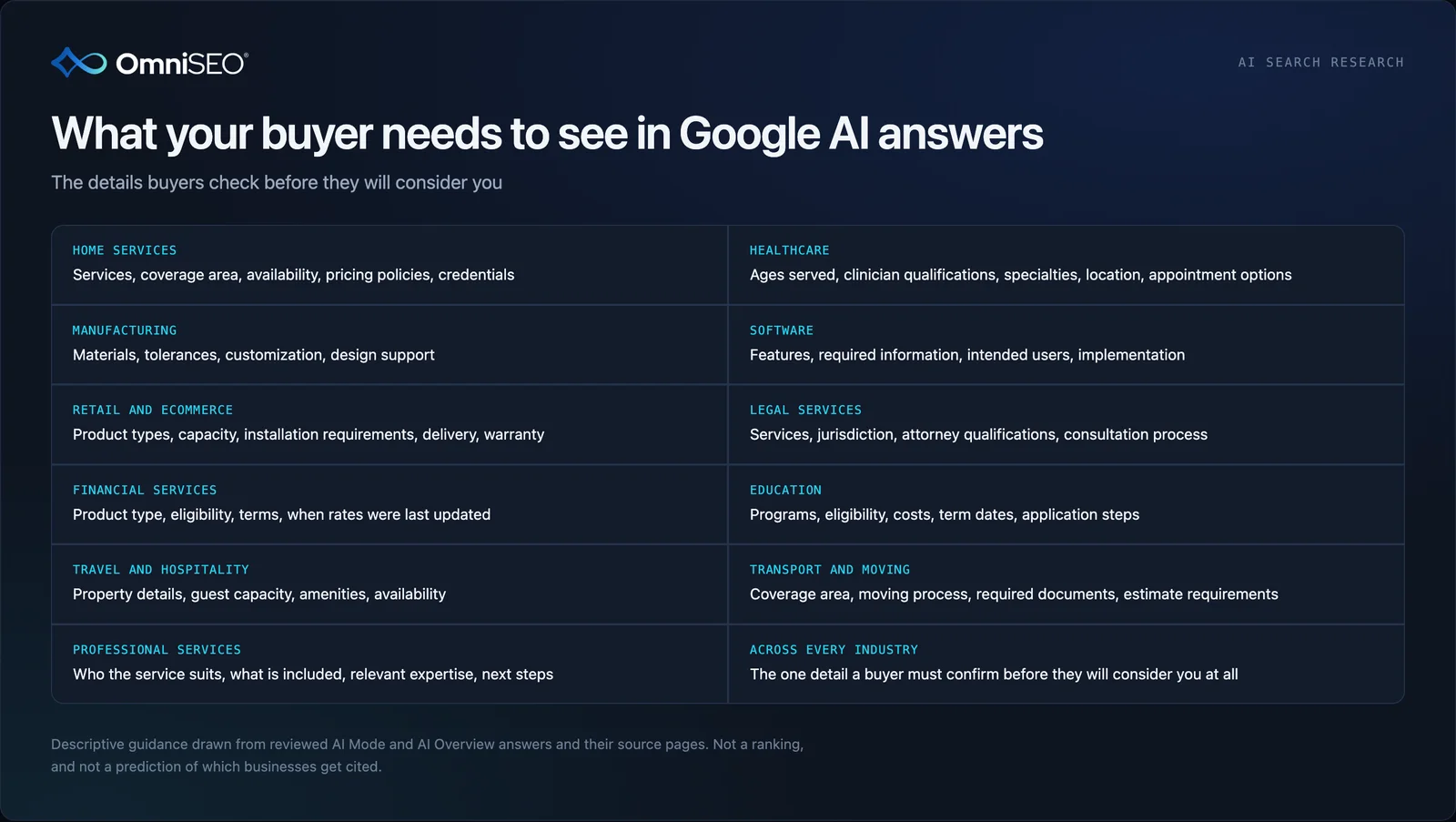
If you want a starting point for that list, here is the kind of detail buyers tend to need confirmed before they will consider you, by industry.
For the questions that want a company, go look at what the web says about you. Search your category the way a buyer would, see which directories and publishers come up, and check whether your details there are right. That's usually the faster win, and almost nobody does it.
Then follow the same questions over time. One appearance proves nothing, which is the standard we're holding our own numbers to.
Our AI visibility metrics guide covers separating mentions from recommendations, and AI citation tracking covers monitoring. OmniSEO tracks AI Mode and AI Overviews separately, with prompt research for finding the questions worth watching in the first place.
So which is it for your category: are buyers asking what, or are they asking who?
Common questions
Why do buying questions link to homepages more often than informational ones?Informational questions are looking for an answer, so the best source is usually a page that explains something. Buying questions are looking for a company, and a homepage is often the most direct way to point at one. In our data, homepages took 9.7% of recorded page links across all questions and 14.9% on choosing and buying questions.
Should I publish more pages to get cited in AI answers?If your site doesn't cover questions your buyers actually ask, yes. What Google warns against is creating near duplicate content for every phrasing of the same search, which it treats as scaled content abuse when the goal is manipulating rankings. Covering more real topics is different from spinning out more versions of one topic.
Are long-tail keywords still worth researching?Yes, as research. Knowing the exact questions buyers ask tells you where your coverage is thin and gives you something to check AI answers against. Google does say you don't need to worry about having enough long-tail keywords in your content, because its systems understand synonyms and generate related queries themselves.
What is query fan-out?Query fan-out is Google's term for the set of concurrent, related queries its AI generates to answer a single question. Google's example is "how to fix a lawn" producing further queries about herbicides, removing weeds without chemicals, and preventing weeds. One user question can pull sources from several related searches.
Does the 90.3% figure prove Google's AI prefers deep pages?Not by itself. Deep pages already make up the vast majority of pages that exist, and no one has published a base rate to compare against, so the figure describes where links landed rather than what Google favors. The gap between the two rows is more reliable, because both were measured the same way.