Google AI Overviews Statistics (2026): The Numbers, Sourced and Dated
Google AI Overviews now reach over 2.5 billion people a month and showed up on 73% to 78% of US desktop searches in Ahrefs' September 2026 crawl. Most stat roundups are still quoting 2024 and 2025 numbers, so here are the current ones, each with its source and date.
Start Free TrialTrack how your brand appears in Google AI Overviews, AI Mode, and ChatGPT.
Google AI Overviews now reach over 2.5 billion people a month and showed up on 73% to 78% of US desktop searches in Ahrefs' September 2026 crawl. When one appears, the #1 organic result sees about a 58% lower click-through rate, and only 37.9% of the URLs it cites rank in the top 10.
Those are the Google AI Overviews statistics that matter right now. The problem is that most roundups you'll find are still quoting 2024 and 2025 numbers that the original publishers have since replaced. I call that stat drift, and stick with me on it, because it's how a lot of bad numbers end up in decks (and in AI answers).
Every number below links to its primary source with the month it was published. Last verified: October 2026.
Key Google AI Overviews statistics at a glance
The headline numbers, newest figure first in each category.
- Users: AI Overviews have over 2.5 billion monthly active users (Google I/O keynote, May 2026).
- Prevalence: AI Overviews appeared on 73.3% of branded and 78.3% of non-branded US desktop keyword SERPs in September 2026 (Ahrefs, Oct 2026).
- CTR: AI Overviews correlate with a 58% lower average click-through rate for the top-ranking page (Ahrefs, Feb 2026).
- Zero-click: 68.01% of US Google searches ended without a click in January to April 2026 (SparkToro, Jun 2026). That covers all searches, not only ones with AI Overviews.
- Citations: Only 37.9% of URLs cited in AI Overviews rank in Google's top 10 (Ahrefs, Mar 2026).
- Most-cited sites: YouTube (22.9%) and Reddit (18.5%) lead the share of citations among the top 50 cited domains (Ahrefs, Sep 2026).
- Accuracy: 89.0% of claims in AI Overviews were consistent with their cited sources, and 2.7% were incorrect (Washington University in St. Louis, May 2026).
- Trust: 53% of US adults who see AI summaries trust them at least somewhat, but only 6% trust them a lot (Pew Research Center, Oct 2025).
- Ads: Ads in AI Overviews now run in English in 12 countries, and advertisers can't opt out of the placement (Google Ads Help, accessed Oct 2026).
How many people use Google AI Overviews?
Over 2.5 billion people a month, according to Google. Sundar Pichai shared the number at Google I/O in May 2026, up from 2 billion a year earlier.
"Monthly users" means people shown at least one AI Overview. Nobody opts in, so this tracks rollout more than demand.
Metric | Value | Source | Date |
|---|---|---|---|
AI Overviews monthly users | 1.5 billion+ | Apr 2025 | |
AI Overviews monthly users | 2 billion+, in 200+ countries and territories and 40 languages | Jul 2025 | |
AI Overviews monthly active users | 2.5 billion+ | May 2026 | |
AI Mode monthly active users | 1 billion+ | May 2026 | |
Clicks sent to websites via AI features | "billions of clicks... every week" | Jul 2026 |
Don't add the two user counts together. AI Mode is a separate, opt-in experience, and the same person can be counted in both. "3.5 billion AI search users" isn't a real number.
One more thing: Google made Gemini 3 the default model for AI Overviews in January 2026, then described AI Overviews and AI Mode as one Search experience on its Q2 2026 call. Keep that in mind when comparing 2026 numbers to older ones.
Is your category showing AI Overviews? Check your queries
Prevalence varies a lot by intent and industry. OmniSEO® tracks the prompts your customers actually ask, so you see your numbers instead of an average.
What percent of Google searches show AI Overviews?
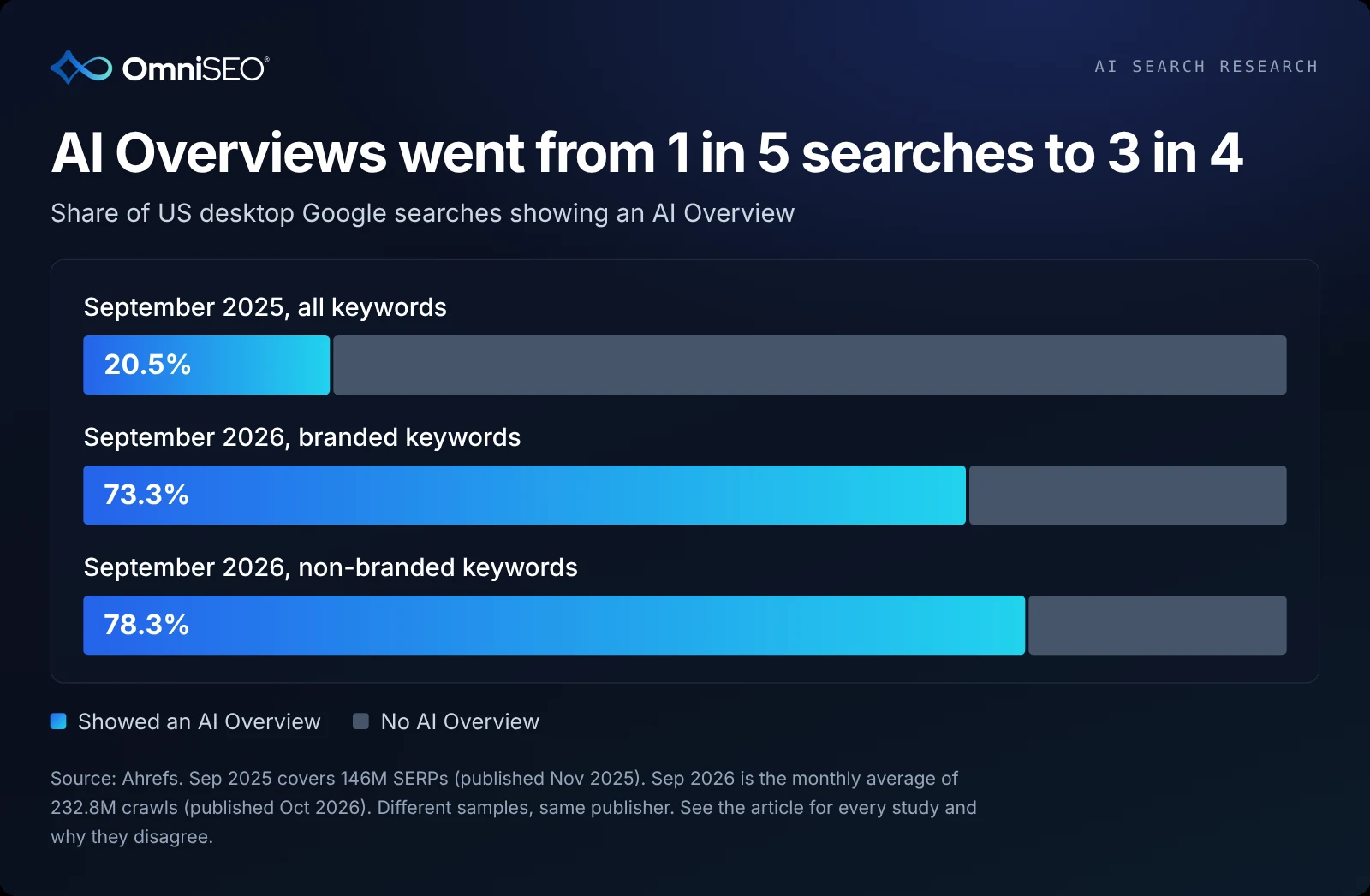
It depends on whose data you read, and the range is huge, from about 6% to over 80%. The newest large crawls sit at the top of that range. Ahrefs found AI Overviews on 73.3% of branded and 78.3% of non-branded US desktop keyword SERPs in September 2026.
That's a real jump. In Ahrefs' own November 2025 study, the figure was 20.5% across 146 million SERPs. Here's how the major readings line up over time.
Source | AI Overview share | Sample | Date of data |
|---|---|---|---|
6.49% of keywords | 10M+ keywords | Jan 2025 | |
18% of real searches | 68,879 searches by 900 US adults | Mar 2025 | |
Semrush | 24.61% (peak) | 10M+ keywords | Jul 2025 |
20.5% of SERPs | 146M US desktop SERPs | Sep 2025 | |
Semrush | 15.69% | 10M+ keywords | Nov 2025 |
~48% of tracked queries | enterprise tracked keywords, 9 industries | Feb 2026 | |
13.7% | 55,393 trending queries | Mar to Apr 2026 | |
more than 40% of US searches | clickstream panel | mid-2026 | |
73.3% branded, 78.3% non-branded | 232.8M US desktop crawls | Sep 2026 |
The pattern: Google expanded in early 2025, pulled back mid-year, then pushed hard in 2026. Ahrefs also found that by September 30, 2026, 63 of 100 top global brand-name queries showed an AI Overview, up from 5 of 98 on July 1.
By query length and type
Longer questions trigger AI Overviews far more often. In Ahrefs' Sep 2025 data, one-word queries showed an AI Overview 9.5% of the time, 5-word queries 27.6%, and queries of 7+ words 46.4%. Queries phrased as questions hit 57.9%, vs 15.5% for non-questions.
By search intent
AI Overviews used to be almost entirely an informational thing. Not anymore. Semrush found that informational queries made up 91.3% of AI Overview triggers in January 2025, but only 57.1% by October 2025. Commercial queries rose to 18.57%, transactional to 13.94% and navigational to 10.33%.
If you sell something, AI Overviews are coming for your bottom-funnel queries too. The branded jump in the Ahrefs 2026 data is the same story.
By industry
Health leads, shopping trails. Ahrefs (Sep 2025) found AI Overviews on 44.1% of medical YMYL queries and 3.2% of shopping queries. Conductor's 2026 benchmarks report put health care at 48.7% vs a 25% average across enterprise sites (Nov 2025).
How much do AI Overviews cut clicks?
Most studies put the click loss somewhere between 15% and 58%. The most-cited current figure is Ahrefs' February 2026 update: when an AI Overview shows, the top-ranking page gets a 58% lower average CTR (0.016 vs an expected 0.037).
That replaced Ahrefs' earlier 34.5% figure, using the same method over a longer window (December 2023 vs December 2025, 300,000 keywords). Here's the rest of the evidence.
Study | Finding | Sample | Date |
|---|---|---|---|
58% lower CTR for position 1. Losses range from 50.8% at position 2 to 19.4% at position 10. | 300K keywords, GSC desktop data | Feb 2026 | |
Organic CTR 2.36% with an AI Overview vs 3.82% without. Brands cited in the AI Overview get ~120% more organic clicks per impression than uncited brands. | 5.47M queries, 53 brands | Apr 2026 | |
People clicked a traditional result on 8% of visits with an AI summary vs 15% without. They clicked a link inside the summary on 1% of visits. | 900 US adults' real browsing | Jul 2025 | |
Pew Research Center | People ended their browsing session on 26% of pages with an AI summary vs 16% without | same | Jul 2025 |
-15.49% average CTR change on AI Overview keywords. Branded keywords with AI Overviews went up 18.68%. | 700K keywords, 10 sites | Apr 2025 |
What it means: the drop is real, but it isn't evenly spread. Being cited inside the AI Overview is the difference between losing some clicks and losing most of them. That's the one finding in this table I'd put in front of a CMO.
Google says total organic clicks from Search have been "relatively stable year-over-year," but hasn't published data to back that up.
Zero-click searches
Zero-click searches are searches that end without a click to any website. SparkToro's analysis of Similarweb panel data found 68.01% of US Google searches ended that way in January to April 2026, up from 60.45% in 2024.
Two caveats: it covers all Google searches, not only ones with AI Overviews, and only 0.34% of those searches moved into AI Mode. So AI Mode isn't where the missing clicks went.
What publishers report
Publisher numbers are mostly secondhand, so treat them as directional. Digital Content Next members saw a median -10% year-over-year drop in Google referral traffic in May and June 2025 (19 companies, reported by Digiday).
Find out if AI Overviews are costing you clicks
Track which of your queries trigger an AI Overview and whether your pages are cited in it, then compare against your Search Console CTR.
Which sources do AI Overviews cite?
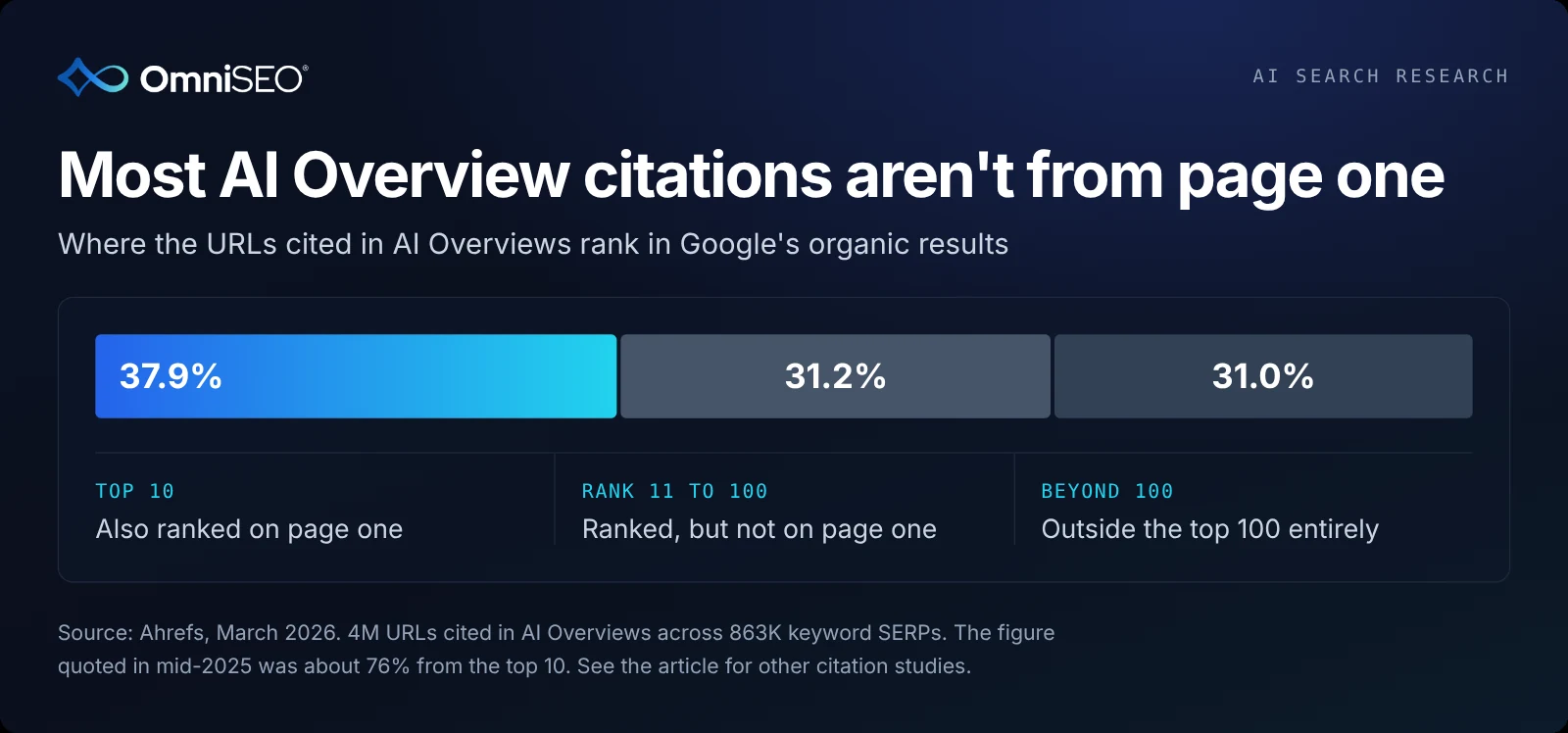
Fewer page-one results than you'd think. Ahrefs found that only 37.9% of URLs cited in AI Overviews also ranked in the top 10 (March 2026, 4 million cited URLs). Another 31.2% ranked 11 to 100, and 31.0% ranked outside the top 100 entirely.
A year earlier, the quoted figure was about 76%. Conductor lands in the same neighborhood as the new Ahrefs number: 57% of AI Overview citations go to pages outside the organic top 10 (167.9 million citations, June to August 2026).
The most-cited domains (Ahrefs, Sep 2026):
Domain | Share of citations among the top 50 domains |
|---|---|
YouTube | 22.9% |
18.5% | |
10.1% | |
google.com | 8.8% |
5.6% | |
Quora | 4.7% |
Wikipedia | 4.0% |
Read that table carefully. These are shares within the 50 most-cited domains (Ahrefs' monthly tracker), not shares of every citation. The Washington University in St. Louis audit found user-generated platforms made up 14.2% of all AI Overview references, vs 41.4% of first-page results.
How many sources does an AI Overview cite? More than it used to:
- A median of 8 references per AI Overview, ranging from 1 to 32 (WashU, 7,583 AI Overviews, May 2026).
- On branded queries, Wikipedia was cited in 71.9% of AI Overviews, YouTube in 38.6% and LinkedIn in 22.8% (Ahrefs, Oct 2026, 100-brand panel).
AI Overviews vs AI Mode citations
AI Mode leans on Google's own properties far more. BrightEdge found google.com made up 44.9% of AI Mode citations vs 9.9% for AI Overviews (US consumer product and finance prompts, January to August 2026). That's 4.5x more self-citation, and it's a good reason to track the two separately.
See which AI Overviews cite your brand
The averages above won't tell you where you stand. OmniSEO® tracks your own prompts across Google AI Overviews, AI Mode, ChatGPT, and Perplexity.
What OmniSEO's own data shows
We looked at every eligible Google AI Mode and AI Overview answer in OmniSEO's 2026 archive. 90.3% of recorded page links pointed past the homepage. On questions about choosing or buying, that dropped to 85.1%.
The gap is the interesting part. Informational questions want an answer, so they link to the page that explains it. Buying questions want a company, and a homepage is often the most direct way to point at one. Homepages took 9.7% of recorded links overall but 14.9% on buying questions.
OmniSEO 2026 archive (Google AI Mode + AI Overviews) | Share of recorded page links |
|---|---|
Links past the homepage, all questions | 90.3% |
Links past the homepage, choosing/buying questions | 85.1% |
Links to homepages, all questions | 9.7% |
Links to homepages, choosing/buying questions | 14.9% |
One honest caveat: deep pages already make up most of the pages that exist, and nobody (us included) has a base rate to compare against. So the 90.3% describes where links landed, not proof of what Google prefers. The gap between the two rows is the more reliable finding. Our full AI Mode and AI Overview link analysis covers the methodology.
We've also caught stat drift happening inside AI answers. In OmniSEO's tracking as of October 2026, a Google AI Mode answer to one of our tracked prompts stated that pages see "a 34.5% lower average click-through rate when an AI Overview is present." That's the number Ahrefs itself replaced eight months earlier. It's one answer, not a trend, but that's stat drift in action.
How accurate are Google AI Overviews?
Mostly accurate, not always. A May 2026 audit of AI Overviews by researchers at Washington University in St. Louis checked 98,020 individual claims from 7,491 AI Overviews. 89.0% were consistent with the cited sources, 2.7% were incorrect, 7.0% left out information, and 1.4% were ambiguous.
A separate test by Oumi for The New York Times found AI Overviews were accurate 91% of the time on Gemini 3, up from 85% on Gemini 2, across 4,326 searches (reported by The New York Times, April 2026). Google pushed back on that study's method.
One number to avoid: "Gemini 3 is wrong 28% of the time" gets passed around as an AI Overview error rate. It describes Gemini 3 without Search grounding, which isn't how AI Overviews work.
The same paper found at least 50.6% of pages cited in AI Overviews carry display ads, so Google's sources are often commercial pages, not just reference sites.
Do people trust AI Overviews?
About half do, a little. Pew Research Center surveyed 5,153 US adults in August 2025. Among people who see AI summaries, 53% have at least some trust in them, 6% trust them a lot, and 46% have not much or no trust.
- Only 20% of people who see them find them extremely or very useful (Pew, Oct 2025).
- 60% of US adults say they read AI search summaries (Pew, Jun 2026, 5,119 adults).
People read them, mostly don't love them, and still click less. My hunch is habit is doing more of the work than trust.
Are there ads in AI Overviews?
Yes. Google launched ads in AI Overviews for mobile users in the US in October 2024, then announced desktop and more countries in May 2025.
- Where they run now: English in 12 countries: Australia, Canada, India, Indonesia, Kenya, Malaysia, New Zealand, Nigeria, Pakistan, the Philippines, Singapore and the US (Google Ads Help).
- What's excluded: sensitive categories including finance, healthcare, gambling, alcohol, politics and adult content.
- Control: advertisers can't target or opt out of the AI Overview placement specifically.
- Ad presence: ads at the bottom of AI Overview results pages showed up about 25% of the time by late 2025, up from under 1% in March 2025 (Semrush, Dec 2025).
AI Mode ads are still early. Google called it "the early stages of experimenting" on its Q4 2025 call.
Why do AI Overview statistics disagree?
Because the studies measure different things. They use different keyword sets, dates, devices and definitions, and Google changed the product twice in 2026. Almost every "conflict" you'll see comes down to one of five drivers.
- Date. Google expanded AI Overviews in early 2025, pulled back mid-year, made Gemini 3 the default in January 2026, and merged AI Overviews and AI Mode into one experience by Q2 2026. A 2025 stat and a 2026 stat are measuring different products.
- Keyword set. Whole keyword databases (Ahrefs, Semrush), enterprise tracked keywords (BrightEdge, Conductor), trending queries (WashU) and real user searches (Pew, Similarweb) will never agree.
- Weighting. Counting each keyword once is different from weighting by how often people actually search it.
- Device. Most tool studies are US desktop only. There's no good current primary source that splits AI Overview presence by mobile vs desktop.
- Intent and industry mix. A health-heavy or question-heavy keyword set triggers far more AI Overviews than a shopping or local one.
Stat | Range reported | Who says what | Why they differ |
|---|---|---|---|
Share of searches with an AI Overview | 6.5% to 83% | Semrush 6.49% (Jan 2025), Ahrefs 20.5% (Sep 2025), BrightEdge ~48% (Feb 2026), Ahrefs 82.91% branded on one day (Sep 2026) | date, keyword set, weighting |
CTR drop | -15% to -58% | Amsive -15.49% (2025), GrowthSRC -32% for position 1 (2025), Ahrefs -58% (2026) | query mix, time window, method |
Cited URLs from the top 10 | 17% to 76% | ~76% (mid-2025), Ahrefs 37.9% (Mar 2026), BrightEdge ~17% (Feb 2026) | Gemini 3 and query fan-out, URL vs domain matching |
User-generated content share | 14% to 41% | WashU 14.2% of all references, Ahrefs YouTube + Reddit 41.4% of top-50 share | different denominators |
AI Overview milestones that break comparisons:
- May 2024: AI Overviews launch in the US.
- October 2024: ads in AI Overviews launch on US mobile.
- January 27, 2026: Gemini 3 becomes the default AI Overviews model globally.
- May 2026: 2.5 billion monthly users, and AI Mode passes 1 billion.
- Q2 2026: Google describes AI Overviews and AI Mode as one Search experience.
AI Overview stats people still misquote
Stat drift is when a superseded statistic keeps getting quoted, first by roundups and then by AI engines, long after the original publisher replaced it. Nobody made these numbers up. They just expired.
Here are the ones I see most:
- "AI Overviews cut clicks by 34.5%." Ahrefs updated it to 58% in February 2026, using the same method.
- "60% of searches are zero-click," credited to AI Overviews or to Bain. Bain's figure came from a December 2024 survey about all searches. The current behavioral number is 68.01% (SparkToro, 2026), and it also covers all Google searches.
- "88% of AI Overview queries are informational." Semrush's own update has it at 57.1% (October 2025 data).
- "76% of AI Overview citations come from the top 10." Ahrefs revised it to 37.9% in March 2026.
- "Reddit is the #1 cited source." In Ahrefs' September 2026 tracker, YouTube is #1 and Reddit is #2.
- "AI Overviews have 2 billion users." That was July 2025. It's 2.5 billion now.
- AI Overview and AI Mode users added together. They overlap. Report them separately.
- "AI visitors convert 4.4x better," used as an AI Overview stat. Those conversion figures cover chatbot referrals (mostly ChatGPT). No primary source isolates conversion rates for visitors who click through from an AI Overview.
- "AI Overviews appear on 58% of queries." That's BrightEdge's growth rate. Presence was about 48%.
- "Google search volume is up 10%." Google said AI Overviews drive over 10% more queries for the types of queries that show them, in its biggest markets, as of mid-2025.
The cold hard truth is that AI engines learn from the same roundups everyone else reads. Stale numbers in, stale numbers out.
How we sourced these statistics
Every statistic here links to its primary source (the original study, or Google's own announcement or earnings call) with the month it was published. We don't cite other stat roundups.
The few figures we could only read secondhand are labeled "reported by." Most third-party studies measure US desktop results, so read prevalence numbers with that in mind. We re-verify this page quarterly. Last check: October 2026.
Start tracking your AI Overview visibility today
Skip the manual spot-checks. OmniSEO® shows whether Google AI Overviews cite you for your queries, and keeps the history so you can see what changes.
What to do with these numbers
Averages don't tell you what's happening to your traffic. Your own queries do, and checking them takes about thirty minutes.
- Pull your top 20 non-branded queries from Google Search Console.
- Search each one and note whether an AI Overview shows and whether you're cited in it. An AI Overview tracker does this automatically and keeps the history (our roundup of AI Overview tracking tools compares the options).
- Compare CTR for those queries against the same months last year in Search Console.
- Split cited from uncited. If the data above holds for you, the uncited queries are where your clicks went.
If you want to go further, our guides on AI citation tracking and AI visibility metrics cover how to separate mentions from citations and report on them.
And before you put any of these numbers in a deck, check the date. Which stat have you been quoting that's already expired?
FAQ
What is the difference between AI Overviews and AI Mode?
AI Overviews are AI-generated summaries that appear at the top of a regular Google results page, with links to the sources they used. AI Mode is a separate conversational search experience for follow-up questions and deeper research. Google reported 2.5 billion monthly users for AI Overviews and 1 billion for AI Mode in May 2026. The two audiences overlap, so the numbers shouldn't be added together.
Do AI Overviews show up on both mobile and desktop?
Yes, AI Overviews appear on both mobile and desktop. Most third-party studies only measure US desktop results, though, and no current primary source compares how often they appear on each device. Treat desktop prevalence figures as a proxy, not a full picture.
Do AI Overviews increase or decrease Google searches?
Google says they increase searches. In July 2025 it reported that AI Overviews drive over 10% more queries for the types of queries that show them, and in 2026 it said queries are at an all-time high. Third-party data shows people click fewer websites per search, so more searches doesn't mean more traffic for publishers.
Can you still get traffic from AI Overviews?
Yes, especially if you're cited. A Seer Interactive study (April 2026) found that brands cited in an AI Overview earn about 120% more organic clicks per impression than brands that aren't, though still fewer than on queries with no AI Overview. Google also says it sends billions of clicks to websites every week through its AI features.